
Proactive AI Chatbots for Shopify: Engage & Convert Leaving Shoppers
Imagine walking into a high-end boutique. You wander around looking at items, pick up a few products, and then walk towards the door. If the store clerk simply stands behind the counter in silence waiting for you to ask a question, they lose a sale. In the physical world, an experienced sales assistant notices your behavior and context, steps in with a timely recommendation, and answers your unvoiced questions.
Most Shopify stores wait for visitors to click the chat bubble. By then, the shopper may already be confused or close to leaving. Proactive AI chatbots for Shopify can open at useful moments, such as exit intent, idle time, or product-page hesitation.
Why are traditional Shopify chatbots failing to drive revenue?
Traditional chatbots wait for the user to initiate contact, engaging only a tiny fraction of store traffic. To drive real ecommerce revenue, you need proactive AI chatbots that recognize exit intent and context, engaging high-intent shoppers with relevant prompts before they leave.
The fundamental flaw of legacy chat tools is their passive nature. Only 1% to 3% of website visitors ever click a static chat bubble. The remaining 97% of your traffic browses in silence, and if they cannot find the answer to a question within seconds, they bounce.
Legacy widgets are built for support triage. If your AI chat agent stays passive, it misses chances to help a warm buyer before they leave. Proactive triggers let chat start the product conversation earlier.
Transitioning to an active, automated assistant is one of the foundational shifts in modern ecommerce. For a deeper look at how AI agents differ from basic legacy chat tools, read our guide on the 7 core benefits of Shopify AI agents in 2026.
How do proactive AI chatbots for Shopify recognize exit intent?
Proactive AI chatbots detect exit intent and idle time with page-specific triggers. Instead of showing the same popup everywhere, the message can match the homepage, collection page, or product page.
When exit intent is detected, Chat Squeeze does not show a generic, annoying pop-up box. Instead, the AI chat agent triggers a highly targeted conversation bubble based on the page template the visitor is browsing:
- General Pages (Home / Landing Pages): The AI chatbot triggers a welcoming, trust-focused question. For example, if a user has spent 30 seconds on the home page without clicking anything, the AI bubble might say: "Looking for something specific? Tell me what you are shopping for and I will point you in the right direction!"
- Collection Pages: When a user stalls on a broad category page, it indicates they are experiencing choice paralysis. The AI agent proactively steps in to help filter options: "We have 50+ items in this collection. What size or color are you looking for? Let me narrow it down for you."
- Product Pages: This is the highest-intent zone. If a shopper is on a product page and moves to close the tab, they likely have a pre-purchase question or doubt (e.g., shipping costs, sizing, or refund policies). The AI proactively asks: "Before you go, do you have any questions about [Product Name]? Ask me about shipping or sizing and I will get you an instant answer!"
By adapting the trigger delay and message template to the page template, you ensure your customers receive highly relevant interactions. To see this in action, you can read our case study on how rescuing a lost customer on a cosmetics product page generated a sale in under 120 seconds.
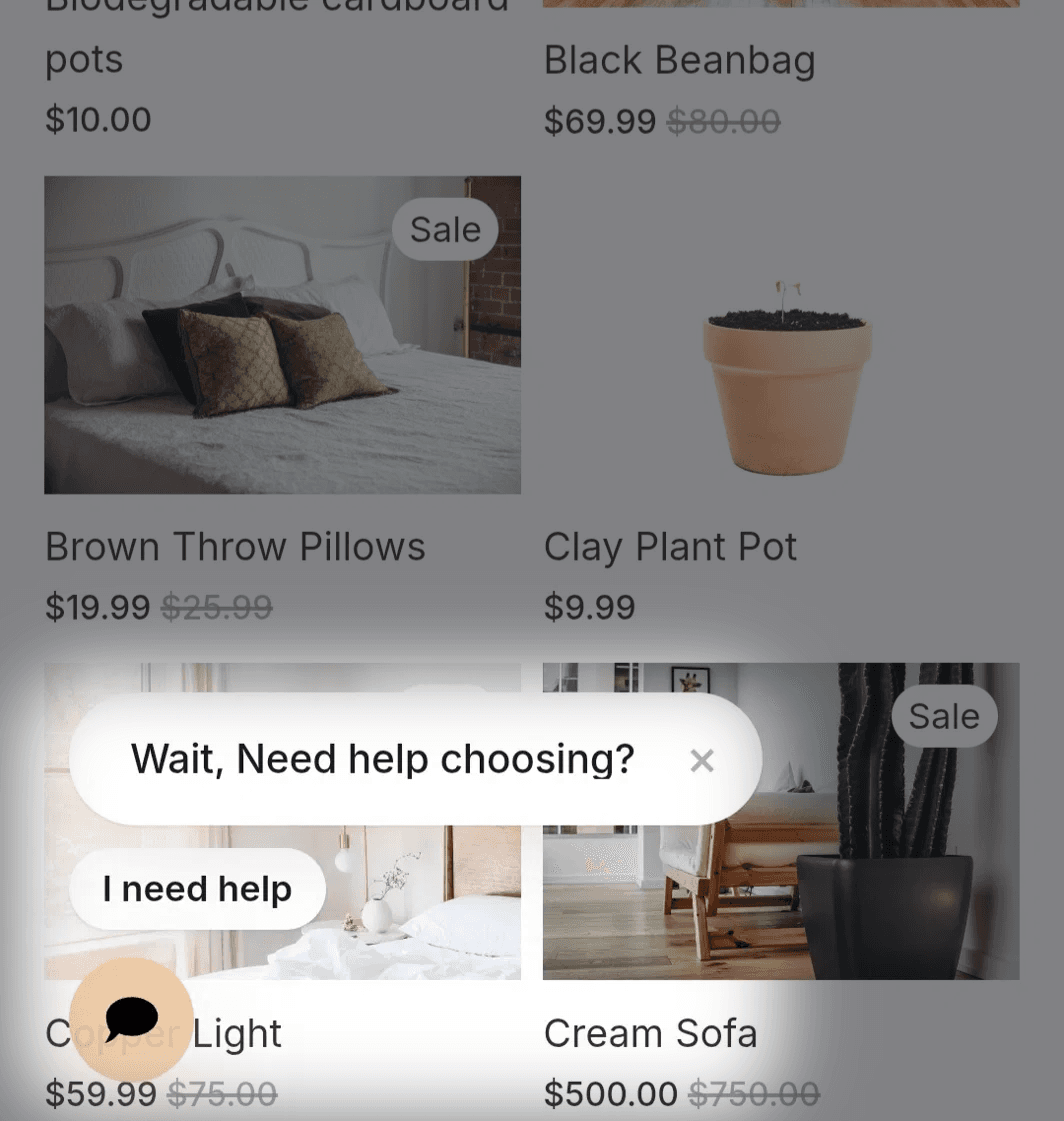
How do you prevent proactive chat triggers from spamming shoppers?
To maintain a high-trust shopping experience, proactive agents must enforce strict trigger deduplication rules. If a customer engages with a page-specific trigger, all other potential triggers across the site are automatically suppressed, protecting the shopper from spam.
There is a thin line between helpful proactive assistance and annoying spam. Traditional popup apps fire multiple discount wheels, newsletter forms, and chat triggers simultaneously, creating a cluttered and frustrating customer experience.
To solve this, Chat Squeeze uses a smart single-role trigger prioritization system. When you configure delays and triggers across your store, the AI chatbot ensures that only one proactive prompt fires per session, based on hierarchy and customer journey state:
- Rule of Precedence: If a customer is browsing a product page, the Product Page Trigger takes full precedence over collection and general page rules.
- Deduplication: Once the customer opens, reads, or closes a proactive trigger bubble, subsequent proactive popups are disabled for the remainder of their visit.
- Intelligent Delay: Triggers only fire after a user has been idle for your specified time (e.g., 15 seconds), ensuring you only assist users who actually need guidance, rather than interrupting active shoppers.
This highly disciplined approach preserves brand integrity, keeps the design clean, and ensures that when the AI chat agent speaks, the customer actually pays attention.
What is context-aware AI chat and why does it outperform questionnaires?
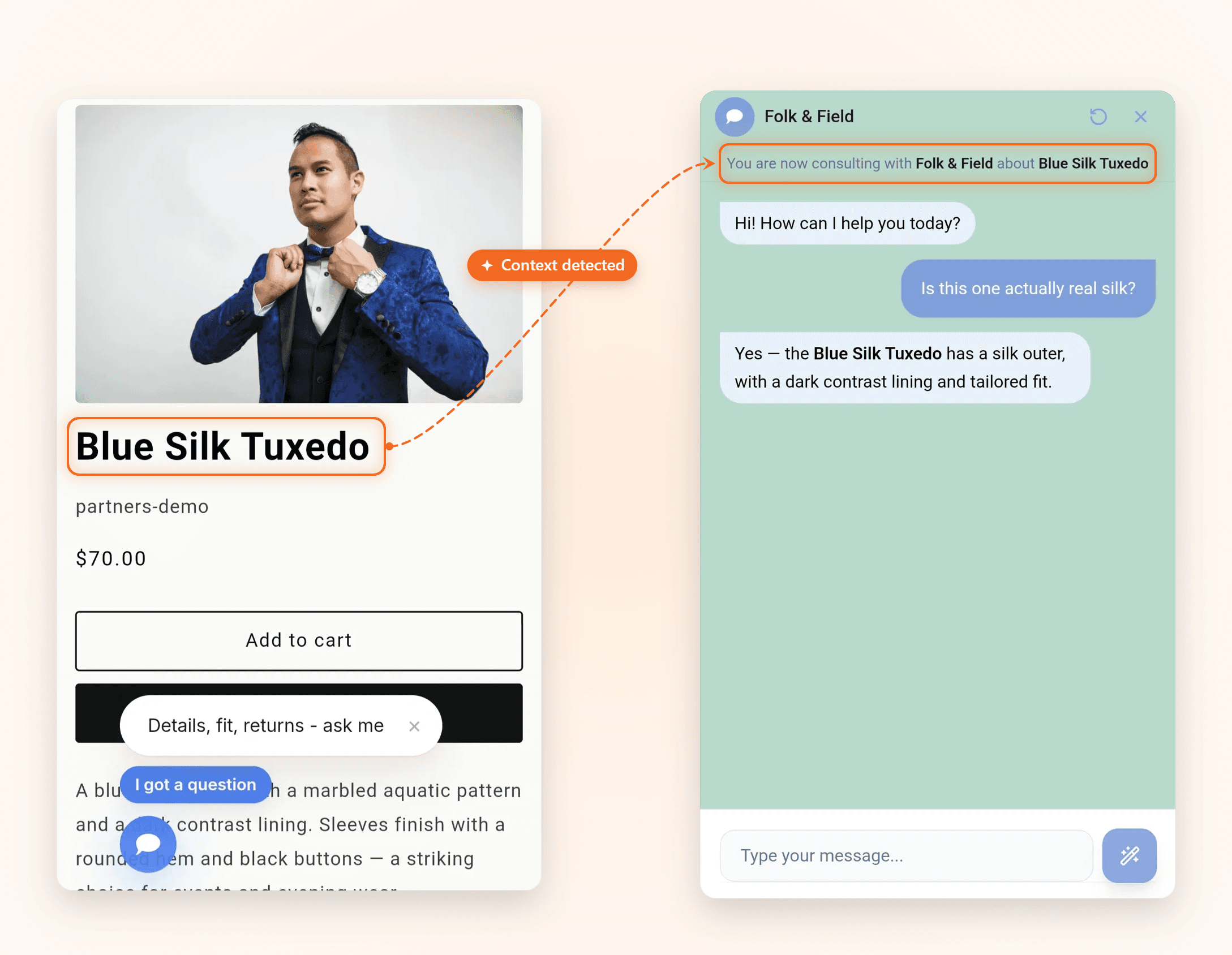
Context-aware AI chat enables the agent to immediately recognize the active URL, product variant, and catalog collection the customer is viewing. By instantly absorbing this metadata, the AI answers product questions immediately without forcing the shopper through a repetitive discovery questionnaire.
Most legacy chatbots greet users with generic options: "Are you looking for products, tracking an order, or looking for support?". This is extremely high-friction. If a customer is currently staring at a pair of red running shoes, the AI chatbot should already know exactly what they are looking at.
An AI chat agent built for Shopify should always be context-aware. The moment a customer asks, "Does this run true to size?" or "Is this in stock in blue?", Chat Squeeze intercepts the active page context:
- •Active Page Metadata: The AI extracts the exact Product ID, title, collections, and variants from the active page URL automatically.
- •Immediate Inventory Sync: Rather than asking the customer to specify the item, the AI instantly references the store catalog database to give an accurate, hallucination-free answer.
- •Zero-Click Discovery: The conversation flows naturally, skipping standard, robotic questionnaire paths and jumping straight to resolution.
By instantly knowing the shopper's exact position in the buying journey, the AI eliminates friction and answers questions in milliseconds. Learn more about how this works behind the scenes in our article on Product Awareness and how it delivers 5X faster customer answers.
What is the conversion impact of proactive, context-aware AI agents?
By catching high-intent browsers exactly at their decision-making moments on collection and product pages, you capture previously lost sales. Stores with proactive AI chat mode enabled see on average 11% cart-to-purchase.
When you replace static, legacy chatbots with a proactive AI chat agent, the revenue impact is immediate. High-intent traffic is captured at the absolute peak of interest:
| Funnel Location | Passive Chatbot Experience | Proactive AI Chat Experience |
|---|---|---|
| Homepage | Sits quietly; receives <1% engagement. | Asks visitors what style they are seeking, driving immediate catalog clicks. |
| Collection Page | Shopper gets overwhelmed and leaves. | AI notices idle behavior and helps narrow down products based on customer preferences. |
| Product Page | Unanswered question on shipping or returns leads to cart abandonment. | Exit intent detects leaving shopper, answers sizing queries instantly, and saves the sale. |
Chat Squeeze can pass captured leads to automation tools such as Klaviyo, Make.com, or Zapier. From there, you can send discount emails, sync customer attributes, or notify your team.
Quick Answers: Proactive AI Chatbots for Shopify
- Does a proactive AI chatbot slow down store performance?
- No. Chat Squeeze is built to load asynchronously, after your theme's main DOM elements, images, and Shopify shopping systems. That keeps the chat script from blocking the first page render.
- Can merchants configure distinct delays for different pages?
- Yes. Every store has different visitor behavior. In the Chat Squeeze dashboard, you can configure inactivity delays, such as 10 seconds on product pages or 30 seconds on collection pages, so triggers better match how shoppers browse.
- How does exit intent work on mobile devices?
- On mobile devices, exit intent detects inactivity and page idle thresholds specifically designed for mobile layouts to trigger helpful, context-aware assistance.
Drive Conversions with Proactive AI
Passive support widgets miss too many buying moments. Page-specific triggers, deduplication, and product context turn chat into a product discovery channel.